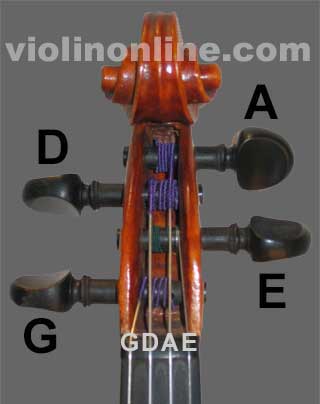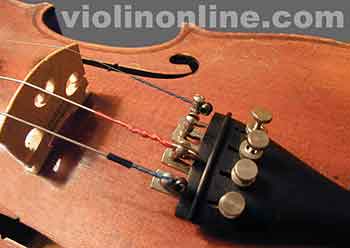
Fine tuners on your violin tailpiece can also help with tuning, especially when you need to make small pitch adjustments.
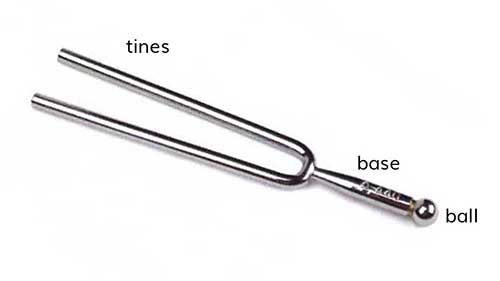
Tune to a tuning fork sound:
Ready for advanced tuning? Try tuning to an “A-440” tuning fork. Directions: hold the base of the tuning fork and tap the tines against something hard, like your knee. Then, while still holding the base, gently touch the ball of the tuning fork to your violin or the top of your bridge. Through the vibration of your instrument, you should hear the ringing sound of an A. Tune to that note! Once your A string is in tune, tune your other strings to your A in perfect fifths.
A digital tuner or app, an “A-440” tuning fork, a pitch pipe, or a piano are all great tuning tools. Digital tuners can be especially helpful for beginners. Some digital tuners even display when the note you’re tuning matches the correct pitch. Visit our Music Store for tuners.
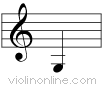
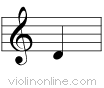
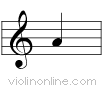
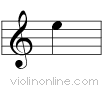
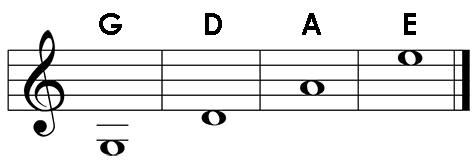
Want to know what a perfect fifth has to do with tuning? The violin’s four strings are tuned in perfect fifths. A perfect fifth (P5) is the interval from the first to the last of five consecutive notes in a diatonic scale. Listen to the P5 pitch difference between each note: G D A E.
Violinists generally tune their A string first to the pitch of A-440, then tune their other violin strings to the A string in perfect fifths. If you’re playing in an orchestra, the oboe typically plays the A for orchestra members to tune to because of its pure, distinctive tone. Even if you’re using a digital tuner to tune each note, listen carefully as you tune. It’s critical that you train your ear to know when you’re in tune, not only for tuning, but also so you’ll be able to play your music in tune!
A-440 is the pitch that most violin A strings are tuned to. A-440 means this pitch has 440 hertz vibration cycles per second (hertz measures frequency). Listen to a tuning fork A-440. Why 440? In an effort to standardize tuning, many countries agreed in the 1930s that A should be 440, and the International Organization for Standardization later selected A at 440 hertz as the standard tuning frequency. Some orchestras still prefer to tune to a higher A, such as A-442.
Beginning violinists often have fine tuners on all four strings to help them easily make small adjustments to the pitch. You can even buy violin tailpieces with integrated fine tuners. Fine tuners can also be very helpful for those who use all-metal strings. Most violins do have a fine tuner on their thin metal E string.
Most violins have an E fine tuner because E is the thinnest string and is more challenging to tune precisely using only the peg. Turn the peg too much and the thin metal string could break. Some violinists feel that more than one fine tuner affects the sound of their instrument, but it’s a personal preference, so decide what works best for you.
Many advanced violinists use double stops when tuning. After your A string is in tune, using double stops to tune the rest of your strings in perfect fifths to the A is an important skill to acquire. A double stop means playing notes on two strings at the same time. Try it! After tuning your A string, listen very carefully for the interval of a perfect fifth and adjust your pegs or fine tuners as needed as you play double stops with the D and A strings, G and D strings, and A and E strings.
If your pegs are slipping, make sure you’re pushing them in while turning. If your pegs are still slipping or too tight to turn securely, you may want to purchase peg compound. If you don’t have peg compound and need a temporary quick fix for slipping or tight pegs, pull the peg partially out and rub pencil graphite on the sticking part of the peg. For loose pegs, pull the violin peg partially out and rub birthday candle wax on the peg to help it stick.
New violin strings usually need time to stretch and settle, so you may need to retune more often during your next few practice sessions. If you need help changing your violin strings, visit our Changing Violin Strings section.
If your instrument is the reason you continue having problems with tuning, you may need to have your pegs reshaped or repaired at a violin shop. It’s also important to take good care of your violin and bow. Learn more in our Instrument Care section.
Disclaimer: Products advertised on this site are sold by outside vendors. Users are advised to carefully investigate the individual store return policies of all online purchases they make. Although we have an affiliate referral relationship with Amazon and Sheet Music Plus and also display Google ads, we do not own or control outside stores selling products accessed through this site, and are not responsible or liable for their company policies or the quality of their merchandise or services. Before buying anything, users are advised to carefully investigate the individual company policies of all online purchases that they intend to make.